The Future of Automation: How AI Agents + Workflows Will Transform Businesses
Automation is entering a new era. What began as simple task automation—sending emails, updating spreadsheets, creating reminders—has evolved into something far more intelligent. The new wave of business transformation is powered by AI Agents + Workflow Automation working together to create self-optimizing, intelligent business systems.
This isn’t the future. It’s happening right now.
Table of Contents
- What Exactly Are AI Agents?
- What AI Agents Can Do
- AI Agents + Workflows: The Most Powerful Automation Model
- What the Future Looks Like
- Every Business Will Have Digital Workers
- Fully Autonomous Workflows
- Zero-Code AI Automation
- Business Apps Will Be Connected by AI, Not APIs
- Hyper-Personalized Customer Experiences
- Create Powerful Automations Effortlessly With AI Agent
- The Future Is Intelligent Automation
What Exactly Are AI Agents?
AI agents work differently. They can understand natural language, recognize intent, and adapt their behavior based on the situation. This makes them far more flexible and intelligent than rule-based automation.
Large language models are the core technology behind AI agents. These models allow AI agents to read emails, understand documents, analyze conversations, and generate meaningful responses. Because of this capability, AI agents can work with unstructured data such as text, chats, PDFs, and messages without needing strict formatting or predefined rules.
AI Agents Can do:
AI agents are capable of handling a wide range of real business tasks that previously required human involvement. They can read emails and instantly understand the intent behind the message, whether it is a support request, a sales inquiry, or an urgent issue. They are also able to analyze documents, extract important information, and understand context from unstructured data such as PDFs, spreadsheets, and reports. Over time, AI agents learn user behavior and recognize patterns, which allows them to improve their responses and decisions continuously.
Because AI agents think dynamically, they do not rely on fixed rules. They can make decisions in real time based on the situation in front of them. Once a decision is made, they can automatically trigger the correct workflow without manual input. This may include updating records, sending messages, creating tasks, or coordinating actions across multiple business applications. AI agents can seamlessly execute tasks across different tools and platforms while communicating in a natural, human-like way, making interactions feel smooth and professional.
AI Agents + Workflows: The Most Powerful Automation Model
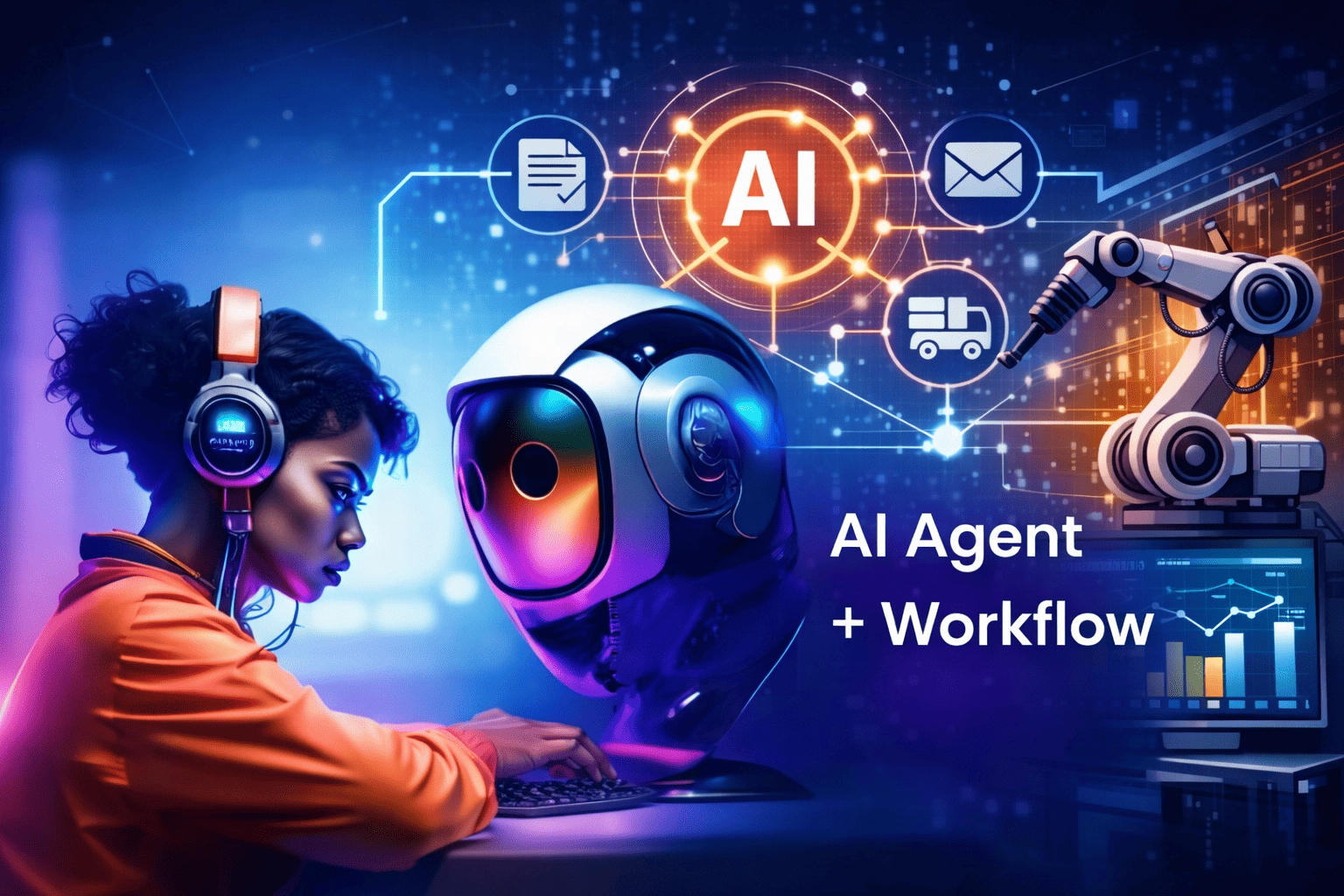
Real transformation happens when AI agents are paired with automated workflows. AI agents act as the thinkers—they interpret messages, understand tone, recognize customer intent, and decide which action fits the scenario. Workflows act as the doers—the systems that update CRMs, send notifications, generate invoices, create tasks, or follow precise business rules. When both work together, businesses get intelligent automation that is capable of making decisions while executing tasks flawlessly.
This shift turns automation from simple rule-based sequences into decision-driven operations that adapt and evolve with real-world scenarios.
How They Work Together
AI Agents = Thinkers
They interpret tone, detect customer intent, extract data, and select the correct action.
Workflows = Doers
They send notifications, update CRMs, create invoices, generate tasks, and follow business rules.
AI Agents (Thinking) + Workflows (Execution) = Intelligent Automation
The true strength of AI agents and workflows lies in their ability to handle uncertainty. Traditional automation depends on predefined paths, which means it often fails when real-world situations change. AI agents remove this limitation by continuously interpreting new information and adjusting decisions in real time. This makes automation more resilient and dependable in fast-moving business environments.
As businesses grow, operations become more complex and harder to manage manually. AI agents reduce this complexity by acting as a central intelligence layer that understands what is happening across systems. Workflows then carry out actions seamlessly in the background. Together, they reduce operational friction and allow teams to focus on strategy instead of repetitive execution.
What the Future Looks Like
Here’s how the world of automation will evolve in the next 2–5 years:
Every Business Will Have “Digital Workers”
In the near future, every business will use digital workers in the same way they hire human employees today. These digital workers are AI agents that can take ownership of specific roles and responsibilities within an organization. Instead of being treated as tools, they will function as active team members that support daily operations and decision-making.
All of this work will happen inside intelligent workflow platforms such as viasocket, where AI agents operate with far more intelligence than traditional automation. By combining decision-making capabilities with execution power, these digital workers will help businesses scale faster, operate more efficiently, and focus human effort on creative and strategic work.
Fully Autonomous Workflows
The future of automation will move away from fixed and rigid workflows toward fully autonomous systems that can adjust themselves in real time. Instead of following a predefined path, these workflows will change their behavior based on the situation they encounter. This allows businesses to automate complex processes without constantly updating rules or conditions.
In these systems, AI agents play a central role by understanding context rather than relying on triggers alone. For example, when a customer sends a message that sounds frustrated or urgent, the AI agent can recognize the tone immediately and decide to route the conversation to a human team member. This decision happens automatically, without any predefined rule telling the system what to do
Zero-Code AI Automation Will Replace Complex Tools
Platforms like viasocket will make automation accessible to everyone.
Instead of: “Create a workflow with 9 steps and conditions”
It becomes:
“Agent, handle my daily reporting tasks” — and it builds the workflow automatically.
Business Apps Will Be Connected by AI, Not APIs
In the future, business applications will no longer need complex API integrations to work together. Instead of building and maintaining manual connectors, AI agents will act as the bridge between different tools and platforms. They will understand how applications work in the same way a human user does, making integrations faster and more flexible.
AI agents will be able to read and understand application interfaces, navigate dashboards, extract relevant information, and trigger actions inside different tools automatically. They can fill forms, move data between systems, and complete tasks without requiring technical integration work. This allows businesses to connect apps that were previously difficult or impossible to integrate.
Hyper-Personalized Customer Experiences Agents will:
Hyper-personalized customer experiences will become the standard as AI agents gain a deeper understanding of individual users. These agents continuously study customer behavior, including past interactions, preferences, browsing patterns, and engagement history. By analyzing this data in real time, they are able to understand what each customer needs at a specific moment rather than relying on generic segments.
Using these insights, AI agents generate personalized responses that feel natural and relevant to each user. Messages, recommendations, and support interactions are tailored based on intent and context, making customers feel understood and valued. At the same time, AI agents trigger custom customer journeys automatically, guiding users through the most effective path across emails, messages, notifications, and in-app experiences.
Create Powerful Automations Effortlessly With AI Agent
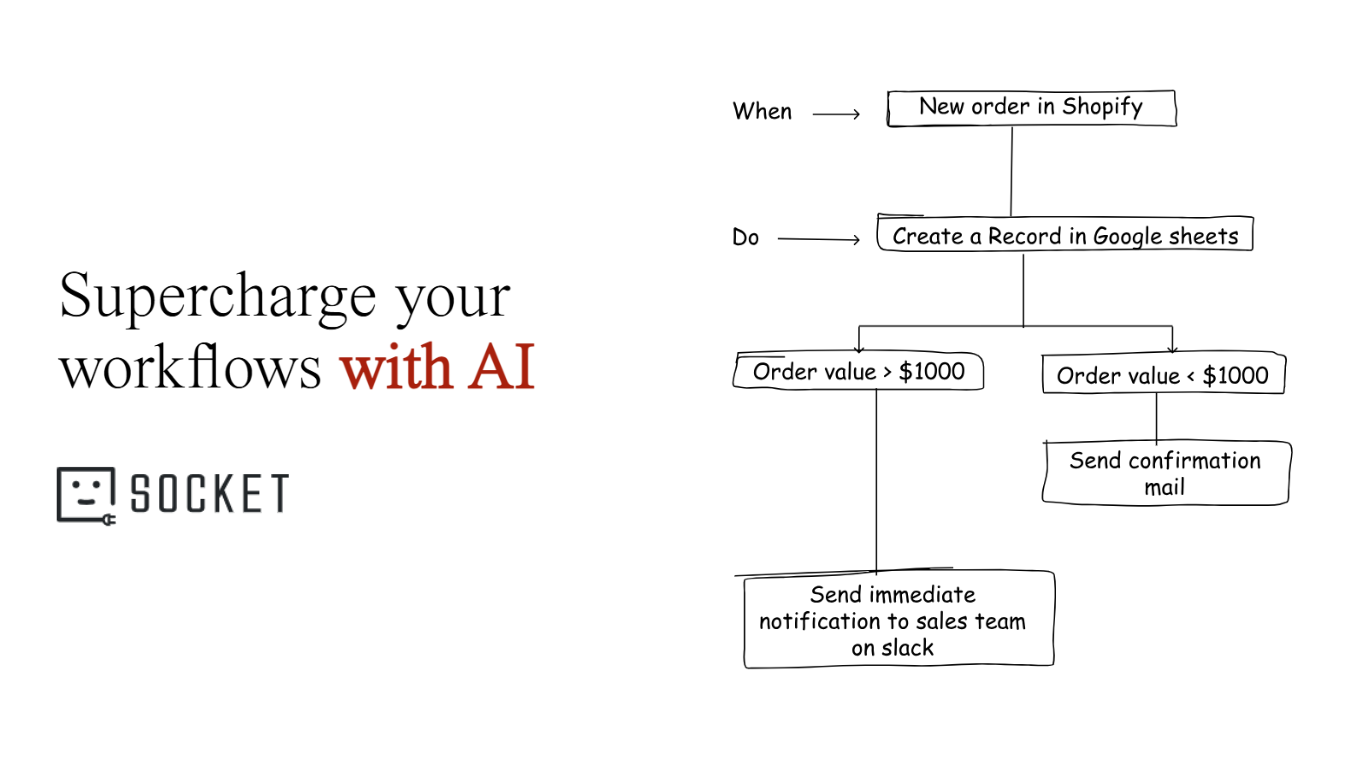
With the viasocket AI Agent, you can build complete workflows simply by explaining what you need. For example, if you tell it, “Build a workflow that sends new Shopify orders to Google Sheets and alerts me on Slack,” the agent understands your request, identifies the right steps, and creates the entire workflow automatically inside ViaSocket. It chooses the apps, connects them, maps the data, and sets everything up—turning a complex automation into a simple conversation.
The Future Is Intelligent Automation
The combination of AI Agents + Intelligent Workflows is not just another trend—it is the next revolution in how businesses operate. Companies that embrace this shift early will move faster, scale more efficiently, deliver superior customer experiences, and outperform competitors. The future belongs to organizations that understand and adopt intelligent automation—and that future is already here.